Codex Argenteus (The Silver Bible), 6th c translation of the Bible into the Gothic language.
Codex Amiatinus, 8th c, the earliest surviving manuscript of the nearly complete Bible (Latin Vulgate).
Codex Abrogans, 8th c glossary from Latin into Old High German
Codex Augiensis, 9th c manuscript of the Pauline Epistles in double parallel columns of Greek and Latin.
The Leningrad Codex (1008) is the oldest complete manuscript of the Hebrew Bible in Hebrew.
Codex Calixtinus, 12th c advice for pilgrims following the Way of St James.
Codex Cumanicus (12th c)
Wiesbaden Codex (ca. 1200), containing the collected works of Hildegard of Bingen. It is a giant codex, weighing 15 kg. A lingua ignota, one of the earliest known constructed languages, is described in it.
In Lebor Ogaim (The book of Ogams) (1390) is an Old Irish treatise on the ogham alphabet.
Flateyjarbók (Flatey Book), 14th c. The sagas of the Norse kings are compiled in this Icelandic manuscript.
Libellus de Medicinalibus Indorum Herbis (Little Book of the Medicinal Herbs of the Indians), translated by Juan Badiano from a Nahuatl original (1552). It is a book describing herbal remedies used by the Aztecs.
Thursday, 24 January 2013

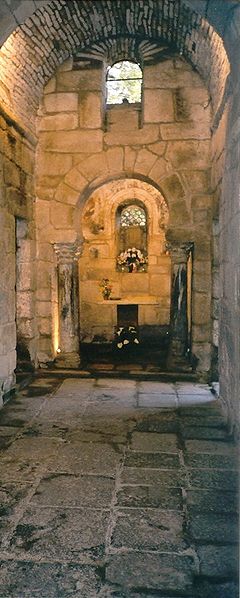
Visigothic Churches in Spain
 | ||||
| Church of San Juan Bautista (Baños de Cerrato. Province of Palencia) (661 AD) |
 | |
| Church of Santa Comba (Bande, province of Orense) (7th c) |
 | |||
| Church of San Pedro de la Nave (Province of Zamora) (c. 680 AD) |
 | |||
| Crypt of San Antolín (Cathedral of Palencia) (7th c) |
 |
| Baptistery of San Miguel de Tarrasa (Barcelona) (7th c) |
 |
| Church of Santa María de Melque (Province of Toledo) (c. 668-729 AD) |
 |
| Hermitage of Santa María (Quintanilla de las Viñas, province of Burgos) (7th c) |
 | ||
Church of San Pedro de la Mata (Sonseca, province of Toledo)
|

Friday, 4 January 2013
50 Books You Should Read
Le Grand Meaulnes (The Lost Domain) by Alain-Fournier
The Trial
by Franz Kafka
The Man Without
Qualities by Robert Musil
Le Père
Goriot by Honoré de Balzac
Lost
Illusions by Honoré de Balzac
Jane Eyre
by Charlotte Brontë
A Study in
Scarlet by Arthur Conan Doyle
A Set of
Six by Joseph Conrad
The
Moonstone by Wilkie Collins
Treasure
Island by Robert L. Stevenson
Kidnapped
& Catriona by Robert L. Stevenson
The Master
of Ballantrae by Robert L. Stevenson
Shirley by
Charlotte Brontë
Pride and
Prejudice by Jane Austen
Emma by
Jane Austen
Alice’s
Adventures in Wonderland by Lewis Carroll
The Little
Prince by Antoine de Saint-Exupéry
Gulliver’s
Travels by Jonathan Swift
Stories by
Augusto Monterroso
Aunt Julia
and the Scriptwriter by Mario Vargas Llosa
Ficciones
by Jorge Luis Borges
Mister President
by Miguel Ángel Asturias
War of Time
by Alejo Carpentier
A World for
Julius by Alfredo Bryce Echenique
Against the
Grain by Joris-Karl Huysmans
The Picture
of Dorian Gray by Oscar Wilde
Letters
from my Windmill by Alphonse Daudet
Odes by
John Keats
Dead Souls
by Nikolai Gogol
Swann’s Way
by Marcel Proust
Great
Expectations by Charles Dickens
A Tale of
Two Cities by Charles Dickens
Bleak House
by Charles Dickens
David
Copperfield by Charles Dickens
Tom Jones
by Henry Fielding
The Idiot
by Fyodor Dostoyevsky
Childhood,
Boyhood and Youth by Leo Tolstoy
Anna
Karenina by Leo Tolstoy
Lancelot,
the Knight of the Cart by Chrétien de Troyes
Lais by
Marie de France
The
Heptameron by Marguerite of Navarre
The Divine
Comedy by Dante Alighieri
Metamorphoses
by Ovid
Life is a
Dream by Pedro Calderón de la Barca
Disdain
with Disdain by Agustín Moreto
Hamlet by
William Shakespeare
Macbeth by
William Shakespeare
The Odyssey
by Homer
The Iliad
by Homer
Don Quixote by Miguel de Cervantes
Thursday, 3 January 2013
9 Great Autobiographies
Leo Tolstoy, Childhood, Boyhood and Youth (1852, 1854, 1856)
Benvenuto Cellini, Vita (1558-1563)
Catalina de Erauso, Lieutenant Nun (1626)
Peter Abelard, Historia calamitatum
Mohamed Choukri, For Bread Alone (1973)
St Augustine, Confessions (397- 398)
Alonso de Contreras, The Adventures of Captain Alonso De Contreras: A 17th Century Journey.
Diego Duque de Estrada, Memoirs of Diego Duque de Estrada
Bernal Díaz del Castillo, The True History of the Conquest of New Spain
Friday, 19 October 2012
6 Diaries and a Notebook
Salvador Dalí, Diary of a Genius.
Hélène Berr, Journal, 1942–1944.http://www.blogger.com/blogger.g?blogID=4314100213811714462#editor/target=post;postID=8782684108804132007
Henri Frédéric Amiel, Journal.
http://www.gutenberg.org/ebooks/8545
Grace Dalrymple Elliott, Journal of my Life during the French Revolution.
The Early Diary of Frances Burney, 1768-1778.
The Log of Christopher Columbus, First Voyage to America in 1492.
L. Da Vinci, Leonardo's Kitchen Notebook.
http://amzn.to/olh9sz
Wednesday, 11 July 2012
7 GREAT HISPANIC NOVELS
Aunt Julia
and the Scriptwriter, Mario Vargas Llosa
The world of radio drama and an unusual loving relationship
are two of the cornerstones of this novel. Its flexible structure is open to
interpolated funny stories. Based on the author's real life experience, this
novel combines a picture of Lima in the 1950s, and an examination of both the
practical and creative aspects of writing.
The Vortex,
José Eustasio Rivera
Trying to escape their problems, Arturo Cova and
his mistress Alicia venture into the Colombian jungle. They start an initiation
trip through the virgin rainforest, a hostile milieu masterfully depicted in the novel. The
author had taken part in an expedition that denounced violence against Indians in
rubber exploitation.
El señor Presidente (Mister President), Miguel Ángel
Asturias
The echoes of the first European avant-garde can
be seen in the narrative techniques employed in this novel, in which a dictatorship
continues its grip on Guatemala through violence and cruelty. A love story provides a counterweight to human
degradation, while a whole country wonders what the next step is.
The Kingdom
of this World, Alejo Carpentier
The slave rebellion in Haiti and mentalities in
contrast are the subjects of this novel, whose baroque prose is one of the
greatest achievements of the Latin American novel. The presence of Voodoo and the
circularity of time help shape this narrative.
Pedro Páramo, Juan Rulfo
At the beginning of this book, two characters move
along a dreamlike landscape. It is a symbolic, invented place, a peculiar hell where
shadows of the dead feed on old feelings and hate. Later the reader realizes
that they are only some of the sleepless ghosts that live in Comala.
Broad and Alien is the World, Ciro Alegría
Peruvian Indian groups are deprived of their lands
and natural wealth, with the acquiescence of the authorities and the passivity and
idleness of a local scholar. Classical narrative techniques are used in this
book that focuses on the dehumanization of life.
A World for Julius, Alfredo Bryce Echenique
The lives and doings of an influential, aristocratic
Peruvian family are the starting point of a novel of satire and social
criticism. The author shows Julius’s expanding world and the decline of his
family. A warm, tender and incisive portrait.
Tuesday, 1 May 2012
Lost Illusions
Honoré de Balzac wrote Lost Illusions (Les illusions perdues)
between 1837 and 1843. The novel is divided into three parts; in the
first one, entitled "The Two Poets", the main character – young Lucien -
is introduced in his milieu, a dreary provincial town. In Angoulême,
Lucien and his friend David inspire each other to pursue their dreams;
David feels more engaged with science, while Lucien decides to become a
writer. The society into which he is introduced is led by Madame de Bargeton, a lady who encourages him to pursue a literary career.
Although
the hero boasts of his noble origins (changing his name to Rubempré),
he represents an impoverished class; Lucien is anxious to recover lost
ground by bringing his artistic talent to bear. The will to succeed as a
writer in Paris will lead him to go beyond moral bounds to improve his
social status. Furthermore, his family is ready to sacrifice everything
for Lucien, in whom they have blind faith. Eve and David - his sister
and brother-in-law - are very much guided by Lucien’s fantasies, as they
want to see him succeed in the task he has taken on.
In Part II (“Un Grand Homme de Province à Paris”), these hopes fade away as Lucien has a first taste of parisian life. His musings about his needs and problems touch on topic of falsehood
in human relations: it is a hard lesson for Lucien. Despite all of
this, he continues his efforts. He sinks deeper, as he frequents bad
company. In a contrast very close to melodrama, actress Coralie
represents the fallen woman, while Eve is depicted as an angel.
Journalism,
and especially, Parisian Bohemianism are well depicted in the novel;
among the intellectuals, D’Arthez is not a fame seeker, but he strives
to produce quality work. As for journalism, it is addressed in a very
critical way. Intellectuals and writers gather at an
unforgettable local tavern, and the depictions of customs of librarians
and printers at that time are also very interesting as well. Furthermore,
David runs a print shop at Angoulême, so it provides greater details.
The last part of the book, entitled “The Travails of an Inventor”,
focuses on David’s problems to make his business thrive.
Despite
all hope, wasted effort increases Lucien’s moral decay. Sand castle
crumbles before his eyes and Lucien plunges into despair. The lives and
doings of Balzac’s characters continue in other books: the outcome of
the story can be found in The Splendors and Miseries of Courtesans (Splendeurs et misères des courtisanes), written between 1838 and 1846.
Subscribe to:
Posts (Atom)